
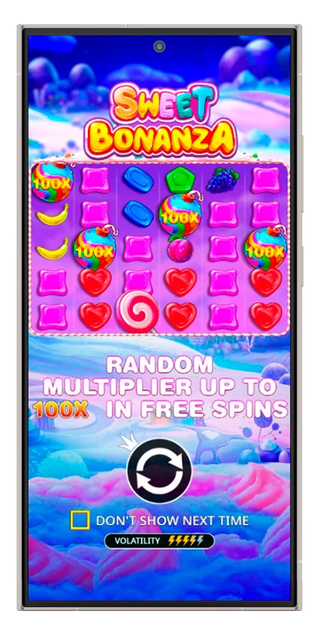






Sweet Bonanza App: Settings and Mobile Gameplay
Discover the mobile version of Sweet Bonanza, set session and payment limits, and play calmly in Poland in 2026 as a legal adult.
Why the Sweet Bonanza App Shines on Mobile
Imagine you only have fifteen minutes between obligations and want to play without unpacking your laptop. You reach for your phone, launch the game, and your only priority is clarity, speed, and calm—no stress. This is exactly when the mobile format reveals whether the gameplay is genuinely comfortable or merely “playable.”
On a phone, ergonomics matter: large buttons, easy bet adjustments, visible balance, and quick access to rules. A good mobile experience doesn’t rely on flashy effects—it ensures you don’t fumble blindly for settings. In 2026, most players engage in short sessions during breaks, so it’s wise to think in blocks: start, a few minutes of gameplay, a break, then decide whether to continue. This approach especially helps legal adults keep entertainment in check rather than jumping back in “just one more time” with no plan.
In Poland, it’s also crucial that the platform complies with local regulations and age-verification requirements for adult users. Practically, this means your account and payments follow specific security procedures, and you have tools for setting limits and breaks. When you configure these beforehand, mobile gameplay shifts from impulsivity to controlled entertainment.
Installation, Login, and Account Security
Imagine you want to start quickly, but after a few minutes you realize you’ve forgotten your password, and your phone auto-saves outdated login data. Irritation follows, and soon the temptation arises to “just get in” and sort things out later. With chance-based games, this is a straightforward recipe for chaos—because if the start is stressful, the session likely will be too.
Begin with calm account preparation: set a strong password, ensure consistent profile data, and enable additional security features if available. In 2026, security is not only technical but also habitual: avoid logging in from others’ devices, don’t leave the app open without screen lock, and steer clear of random networks. These small measures save stress later, especially during extra verification steps at payment times.
For legal adults in Poland, organizational aspects are equally important: before starting gameplay, set limits in your account. If time and deposit limits are active, you’ll face fewer situations where you “lose track” on your phone. This isn’t moralizing—it’s practice: the simpler the start process, the less room for impulsivity.
Game Settings and Tempo Control on Screen
Imagine you’re playing mobile in a queue when someone interrupts you, and you accidentally keep clicking forward, wanting to “finish your streak.” Soon after, you can’t recall whether you changed your bet or inadvertently activated faster speed. That’s why your first interaction with the game should be technical, not emotional—first master the screen, only then play longer.
Start with three things: where to adjust your bet, how to stop autoplay, and where to find rules and payout tables. Once you know these, it’s easier to maintain rhythm. The safest approach is to play in time blocks without changing settings mid-block, as most “mistakes” occur when reacting emotionally.
If you’re a legal adult playing on a platform available in Poland, treat tempo control as part of entertainment hygiene. Speed on mobile increases faster than on desktop—that’s life, not theory. Thus, scheduled breaks and fixed bets per block form the simplest shield.
How to Read the Screen and Adjust Bets Without Errors
Imagine you simply want to slightly lower your bet, but your finger taps elsewhere, and suddenly the game speeds up. Frustration follows, quickly leading to the reflexive thought: “Fine, whatever, I’ll just keep playing.” Better to do the opposite—pause, return to settings, and ensure everything matches your plan.
First, set a bet level that allows calm gameplay throughout your time block. If your session budget is limited, your bet should create space, not pressure. Then check if the screen clearly shows: current bet, balance, and value of the last win. These are small details, but when legible, you won’t feel compelled to “click quickly.”
A highly effective simple habit: after every few minutes, take a short pause and ask yourself if you’re still following your plan. If you sense yourself speeding up, this signals a break—not a bet change. In mobile gameplay, control matters more than speed.
Cascades, Multipliers, and Symbolism: What You See in a Session
Imagine a flashy sequence occurs, and you instinctively assume “now it has to continue.” In practice, such moments intensify emotions, and emotions love whispering: “Just stay a bit longer.” Rather than following this urge, better to understand exactly what happened on-screen and how it impacted the round’s flow.
In games with cascading mechanics, results build in stages. One symbol disappearance need not mean a large win, but may create space for the next combination. Multipliers, when they appear, serve as bonuses that can alter session perception—but shouldn’t alter your plan. That’s key: your plan must remain steady regardless of whether things were “hot” or “cold.”
If you wish to play calmly, observe rhythm: how often small wins occur, animation speed, and whether you understand the results’ origin. When something’s unclear, revisit the rules and check feature descriptions instead of guessing. Guessing in practice leads to haste.
Demo Mode as Warm-up
Treat the demo mode as a training ground for building habits. Set a short timer, choose one bet, and test whether you can finish the test exactly when planned. The demo isn’t about “proving” results, but about observing how you respond to tempo and whether you handle settings without tension.
Autoplay, Turbo, and Emergency Pause
Autoplay and faster-speed modes can conveniently shorten rounds but may also steal your sense of time. In mobile play, having an “emergency pause” is useful: awareness of how to instantly stop gameplay if you feel haste. If you tend toward autopilot, better to play manually and take scheduled breaks rather than handing tempo control over to the machine.
Deposits and Withdrawals in Poland: What Simplifies the Process
Imagine after a short, successful session you wish to request a withdrawal, but you do so emotionally and start altering account settings “for faster processing.” Usually, the opposite happens—additional security steps emerge and stress rises. Payments work best when treated as a separate process, independent of gameplay results.
For legal adults in Poland, a simple structure pays off: one deposit method, consistent profile data, and no frantic changes during operations. If the platform requests additional age or data verification, handle it calmly—it’s part of security and compliance with adult-user regulations. The greatest advantage is order: when your account is prepared beforehand, financial steps won’t spoil gameplay.
Area | What to Set Before Playing | What Helps Most | What Most Hinders |
Session Budget | Fixed amount per block | Pre-set deposit limit | Adding funds while emotional |
Payment Method | One verified option | Consistent profile data | Changing method “at the last minute” |
Verification | Ready for confirmations | Calm execution of steps | Data corrections during process |
Withdrawal | Request after session ends | No concurrent changes | Anxious re-attempts and chaos in settings |
Support | Describe issue step by step | Specific: stage and error message | Vague “doesn’t work” without details |
Deposit Step-by-Step with Budget Limit
Imagine making a deposit “just for a moment” without setting a limit, and suddenly the session extends because the balance allows it. This isn’t about character but about conditions—the more space there is, the easier it fills. Therefore, first set deposit and session limits, then execute the transaction.
The simplest routine looks like this: choose an amount for one session, set the limit, confirm the transaction, and check your balance. Only then start the game. If something distracts you, better delay the start by a minute than begin in chaos. In chance games, a calm start is a real advantage, as it curbs impulsive bet changes.
After depositing, return to your plan: one bet per block, breaks at set intervals, end according to the limit. When budget sets the boundaries, gameplay remains entertainment.
Withdrawal Without Hasty Moves
Imagine you want to withdraw funds immediately, but meanwhile you’re editing your profile data, thinking “it’ll be safer that way.” Security systems often react to sudden changes, so instead of speeding things up, you might trigger additional verifications. The best rule: withdraw after the session, without changes during it.
A simple scheme works well: finish your gameplay block, take a short break, then request withdrawal. If an extra verification step appears, handle it calmly and carefully. In Poland, adult-user procedures are part of the standard, so patience here is part of hygiene.
Most important: don’t try to “vent” through gameplay. If finances stress you, halt gameplay. Withdrawals and emotions make a volatile mix that usually ends in stressed decisions.
Contacting Support and Verification Documents
Imagine writing support “doesn’t work,” then waiting while you must clarify everything in subsequent messages. This prolongs the issue and increases stress. Better to immediately describe: what you did, which stage you’re on, what message you see, and which operation concerns the problem.
If requests for verification documents appear, treat them as a security element and adult user policy—not as an “obstacle.” Consistency of data matters most: one version of information in the profile and no “in-the-moment” corrections. When everything is organized, procedures are simply the next step—not a source of stress.
When communicating with support, stick to facts and avoid making multiple changes at once. One change, one test, one response. This approach leads to solutions faster and protects you from impulsive decisions.
Limits, Timeouts, and Gaming Hygiene in 2026
Imagine logging into a game after a tough day “just to unwind,” yet after a few minutes you feel tense, because you want the gameplay to deliver a specific outcome. This is the moment when limits shift from theory to practical tool. For adult players in 2026, the priority is maintaining control over time and budget, regardless of mood.
Gaming hygiene consists of simple rules: play in blocks, take breaks, don’t chase losses, and don’t change stakes under emotional influence. If the platform is available in Poland, it should offer break options and restrictions—use them proactively. Limits work best when you don’t need to remember them, because they’re set automatically.
When you treat gameplay like a plan rather than a “let’s see what happens” approach, the experience becomes calmer. And that is the goal: entertainment—not tension.
Time Limit: How to Set and Stick to a Plan
Imagine telling yourself “I’ll play ten minutes,” then thinking, “just three more spins and I’ll stop.” After three spins, three more follow, and suddenly an hour passes. A time limit solves this issue without negotiation—the block is fixed, and the end is definitive.
Set the timer before starting. If playing on mobile, choose real, not ambitious, time—shorter and calmer is better than long and stressful. After a block ends, take a break before deciding whether to continue with another block. This separates decisions from emotions.
If you feel yourself speeding up, end the block early. In practice, this is better than trying to “catch up” the pace. Time should be your tool—not a trap.
Deposit Limit and the One-Budget Rule
Imagine your budget is exhausted, but you feel like “it’s almost there.” The temptation arises to add “just a little more,” since it’s not excessive—yet. Often, this is how the spiral of additional deposits begins, ruining the entertainment experience.
The one-budget rule is simple: when your session budget runs out, the session ends—no top-ups during play. If you wish to return, do so tomorrow—or after a longer break—when your decision is calm. Deposit limits in your account help because they function even when emotions suggest otherwise.
In 2026, this is standard for adult players: financial control should be automatic, so you never need to prove “willpower” mid-session.
In-Session Breaks: A Reset for the Mind
Imagine playing on your phone while watching a series, then suddenly realize you’re clicking without paying attention to outcomes. That’s autopilot. A break acts like a reset: it cuts off stimuli, brings you back to your plan, and sometimes ends the session before it becomes stressful.
Set reminders for breaks every 10–15 minutes. During the break, put your phone away, stand up, drink water, and take two deep breaths. It sounds trivial, yet it works—because it breaks the “just one more” cycle. After the break, decide whether to continue or end your session.
Crucially, breaks should be planned—not reactive. If you only take them when already agitated, it’s harder to benefit. Regular breaks become neutral habits.
Longer Breaks: When It’s Worth Stopping Gameplay
Imagine returning to play not for fun, but to improve your mood or “reclaim” a previous loss. Even a short session can turn into a long, draining block. A longer break is the best decision in such cases.
Timeouts or extended self-exclusion are hygiene tools for adult users—they don’t “take away fun,” they protect against repetitive patterns. If you notice you’re playing more often than planned, can’t stop on time, or increase stakes under stress—stop.
In 2026, this approach is mature—not embarrassing. Entertainment should support calmness—not erode it.

Common App Mistakes and Quick Fixes
Imagine everything was supposed to be “chill,” yet within moments you catch yourself nervously checking your balance and changing settings every few minutes. This usually stems not from the game itself, but from a lack of structure: no time limit, no session budget, no breaks. Good news—it’s fixable in minutes, provided you know what to do.
The most common mistake #1 is rushing at the start: quick login, quick deposit, quick stake change. Fix: set limits first, then payment, gameplay last. Mistake #2: changing stakes based on emotions. Fix: one stake per block, changes only after a break. Mistake #3: playing “in the background” without time control. Fix: use a timer and break reminders.
If you’re an adult player in Poland, treat these fixes as standard—not optional. You don’t need a complex strategy—just order.
Checklist for Your First Session
Imagine you have half an hour and want to finish with a sense of control. First, set the timer; then, the budget and deposit limit; finally, start the game. If within minutes you feel rushed, don’t “speed up”—take a break instead.
The checklist is simple: one stake per block, breaks every 10–15 minutes, end on time, no top-ups mid-session. Additionally, keep your account in order: consistent data and phone security. If contacting support, describe the issue clearly, step by step.
Most importantly: don’t try to control randomness—control yourself. That’s the only thing that always works.
FAQ
How to install the mobile app for Sweet Bonanza?
Safest approach: start by organizing your phone and account—update your OS, enable screen lock, then calmly complete installation through your device’s standard app store. Rushing increases the chance of skipping security settings, leading to frustration later with extra confirmations. After installation, immediately set a strong password and verify whether time and deposit limits are available in your account—this is the simplest way for adults to manage sessions. Only after these steps are complete should you launch the game for its first, short trial run.
Can you play on mobile without installing the app?
Mobile web access is often possible, but comfort depends on your device, internet stability, and whether adjusting settings on a small screen is manageable. Imagine playing while running and suddenly needing to pause gameplay—here, ergonomics and quick access to tempo controls matter. Regardless of format, the essentials remain the same: time limits, session budgets, and breaks—otherwise, mobile play easily slips into autopilot. For calm, choose the option where finding settings and ending on time is easiest.
How to set time limits before your first session?
Set a timer for a specific block—e.g., 20–40 minutes—and treat the end as a hard boundary, not a suggestion. The main issue isn’t that players “can’t stop,” but that they lack a stop point and start negotiating “just three more spins.” If your account offers break reminders, enable them right away and take pauses every 10–15 minutes—this resets emotions. As an adult player, limits should function automatically so you don’t have to recall them during stress.
What to do when I start increasing stakes out of nervousness?
First, end the current block and take a screen-free break—even if brief—because tension rarely leads to good decisions. Then return to the simple plan: keep a constant stake in the next block or end the session as per your budget. Increasing stakes usually attempts to “speed things up,” but in chance-based games this doesn’t work—only self-regulated pacing does. If you notice this pattern recurring, set stricter deposit limits or use timeout to interrupt the impulse.
Why might a withdrawal require additional verification?
Additional verification steps are standard security for adult users, protecting your account and funds. Delays usually arise from inconsistency: profile data corrections mid-process, mixing payment methods, or anxious repeated attempts. If you seek calmness, initiate withdrawals after finishing your session and avoid changing settings during operations. When requesting confirmations, complete them carefully and without shortcuts—this typically shortens the path to resolution.
How to play mobile without slipping into autopilot?
Best approach: play in short blocks and pre-plan breaks, rather than relying on “self-control” mid-emotion. Imagine playing in the background while watching a show and suddenly not remembering how much time passed—that’s a sign tempo has taken over. Timer, break reminders, and consistent stakes per block act as guardrails, keeping entertainment within safe limits for adults. If you feel rushed, end the block early—better to finish calmly than prolong it “just a bit more.”
When is it worth taking a longer break from playing?
When you notice returning to gameplay not for fun, but out of tension, frustration, or a desire to “make up for” losses—and sessions extend despite lack of satisfaction. In such cases, short breaks may not suffice, as the impulse returns faster than you can cool it down. Timeout or a longer pause helps break the cycle and lets you return only when decisions are calm. This is a mature tool for adult entertainment hygiene—not an “extreme measure.”